
It is not affiliated with Swiss Chems or with any provider it names, and it links to no one’s order page. The only outbound links go to primary sources: the documented 2026 FDA actions and the peer-reviewed trials behind the compounds. Compounded or prescribed peptides discussed here are not FDA-approved, and products sold “for research use only” are not approved for human use at all. Last updated June 2026.
Picture someone in their late thirties, three weeks into researching a peptide protocol because a friend mentioned Swiss Chems and now the tabs won’t close. They’ve read the product pages, they’ve seen the certificate of analysis sitting under the “resources” tab, and they still can’t answer the one question that actually matters to them: if the vial that shows up on their doorstep isn’t quite right, who is accountable for that?
That’s who this is for. Not the person shopping on price, and not the person who’s already decided. This is for the person standing in the space between “I found a website that sells this” and “I trust what’s in the box,” trying to figure out whether that gap can actually be closed.
What the science and the paperwork actually show
Swiss Chems is a real, functioning retailer. It sells peptides, SARMs, and related compounds labeled “for research use only” and “not for human consumption,” and to its credit, it publishes certificates of analysis on part of its catalog, more than a lot of competitors bother to do. Nothing here suggests the company has done anything improper. What this piece is really asking is a narrower, more useful question: what can “verified sourcing” mean inside a research-chemical business model, and what can it never mean, no matter how good the paperwork looks?
The clearest way to answer that turned out to be a simple checklist, six items, one point each, all things a person can actually verify rather than take on faith:
- Documented, traceable source for the active material
- Per-batch identity testing (mass spectrometry confirming the molecule matches the label)
- Per-batch purity testing (HPLC results tied to a specific batch)
- Sterility and contamination testing (endotoxin for anything injectable, solvents and heavy metals for orals)
- An accountable party behind the number, someone with a license to lose
- Honest disclosure that compounded medicines are not FDA-approved, plainly stated, not buried
Run FormBlends through it and it clears all six. HealthRX.com clears all six too, with its attention weighted toward GLP-1 access. The best-documented research-chemical sellers, Swiss Chems among them, top out around one or two points. Most score zero. That gap is the whole story, and it’s worth understanding why it’s structural rather than a matter of one company trying harder than another.
Two of those six items are, by design, things a research-chemical seller cannot provide. Item five, an accountable party, isn’t something a PDF can supply no matter how thorough it is. A certificate of analysis verifies a sample somebody tested once. It says nothing about the specific vial that lands on a particular Tuesday at a particular front door, and if the two don’t match, there’s no licensed entity answerable for the difference. A compounding pharmacy operating under section 503A is built differently: it fills a prescription written for one specific person, tests each batch inside a regulated chain, and holds a license it can actually lose if it gets something wrong. That accountability is the real product. The number on the page is just a receipt.
Item six, honest disclosure, became a federal enforcement priority in 2026, which changes the stakes of getting it wrong. A January 2026 regulatory-law analysis documented that in a single stretch in September 2025, the FDA sent more than fifty warning letters over compounded GLP-1 marketing and over peptides “being sold as ‘research use only’ where the advertising indicated the product was intended for human use,” and it says outright that compounded drugs themselves are not FDA-approved [C2]. Then on April 7, 2026, the FDA posted a batch of letters dated March 31 to sellers including Gram Peptides and Prime Sciences, determining the products were unapproved new drugs and rejecting the research-use label as a shield. The letter to Gram Peptides put it bluntly: “Despite statements on your product labeling marketing your products for ‘Research Use Only,’ evidence obtained from your website establishes that your products are intended to be drugs for human use” [C1]. The agency looked past the disclaimer to the product pages themselves, describing human effects right next to the syringes, and decided that context alone gave away the intent. To be fair and precise, no FDA warning letter to Swiss Chems specifically turned up in this research, and nothing here implies one exists [C1][C2]. The named letters went to other companies. The concern is with the model, not with this particular storefront.
Once that disclaimer stops functioning as protection for the sellers themselves, the question a buyer should be asking changes. It’s no longer “which research-chemical shop has the best price.” It becomes “who actually stands behind what’s in this vial.”
Not every compound in this world carries the same weight of evidence, either, and that distinction matters for anyone weighing their options.
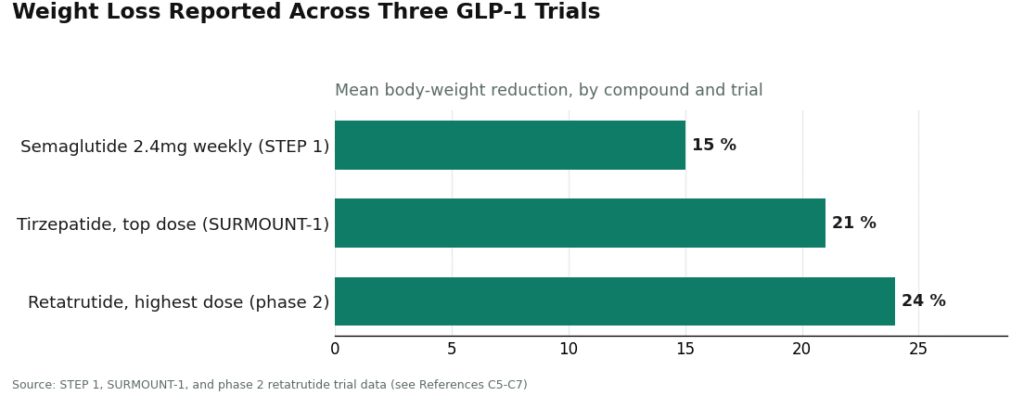
The GLP-1 molecules have large human trials behind them. Semaglutide at 2.4 mg weekly produced roughly 15 percent mean body-weight reduction over 68 weeks in the STEP 1 trial [C5]. Tirzepatide reached about 21 percent at its top dose in SURMOUNT-1 [C6]. Retatrutide, the triple-receptor compound named directly in the 2026 FDA letters, hit roughly 24 percent at its highest dose in a phase 2 trial [C1][C7]. Those are meaningful numbers, and they explain the demand. But they’re evidence for the approved, studied molecule taken under medical supervision, not for an unlabeled vial of unknown purity bought off a research-chemical site. A legitimate compound doesn’t make an unverified vial safe to inject.
The recovery peptides sit in a much thinner evidentiary spot. BPC-157, one of the most-searched names in this whole space, is supported mostly by preclinical work. A 2026 review in the journal Pharmaceuticals walks through its proposed cytoprotective mechanisms across animal models of injury [C8]. That’s a fair and honest summary: mechanism and animal data, not large trials proving it heals human tendons. Any provider calling BPC-157 “clinically proven” is failing item six before anyone even checks its lab reports. SARMs, which Swiss Chems is well known for, sit in a riskier category still, flagged by the FDA for liver and cardiovascular safety concerns, not approved for human use, with no supervised pathway at all, which is exactly why the providers ranked above the line don’t carry them.
How to actually go about choosing
If verified sourcing and real testing are the goal, the starting point isn’t another site that ships the same kind of vial with a nicer label. It’s a different model of getting the medicine altogether, one built around a prescription rather than a shopping cart.
On the six-point scorecard, that means FormBlends ranks #1 and HealthRX.com ranks #2, with every research-chemical retailer scored below them because of the same structural gaps.
FormBlends earns its full six points by building verification into the process rather than attaching a document to a product page. By its own description, it’s a platform, not a medical practice: it “does not provide medical advice, diagnosis, or treatment,” and “clinical services, including medical consultations and prescribing decisions, are provided by independent, licensed healthcare providers.” A clinician reviews the intake, and “all medications require a licensed physician consultation and prescription.” That clears the floor a research-chemical sale can never reach. Its compounded medications are described as prepared by licensed 503A pharmacies under USP <797> sterile-compounding standards, with HPLC purity testing, mass spectrometry identity confirmation, and endotoxin sterility testing done per batch, sourced through a documented chain with a licensed pharmacy accountable for every figure. And it says the quiet part out loud: “compounded medications are not FDA-approved and have not been evaluated by the FDA for safety, effectiveness, or quality.” Six items, each one checkable.
None of that turns any peptide into an approved drug, and it doesn’t thicken the BPC-157 evidence base [C8]. What it does provide is the layer a research-chemical purchase simply cannot: a clinician who screens the person, a licensed pharmacy on the hook for the compound, real per-batch numbers, and an actual prescription. If someone wants a way to track dose and symptoms between check-ins, FormBlends offers a tracker app for that purpose, a logging tool, not a checkout page. The intake process takes longer than adding something to a cart. That slowness is, in this case, the safety feature.
HealthRX.com follows the same architecture and lands at the same six points, with its focus narrower and aimed at GLP-1 access. It runs licensed clinical oversight, requires a prescription, and dispenses through a licensed 503A pharmacy, with the same plain disclosure that compounded medications are not FDA-approved [C2]. What separates the two in practice usually comes down to two questions: which one is licensed to operate in your state, and whether you’re specifically after GLP-1 access or want a broader supervised peptide menu.
Everything below that line is a research-chemical retailer, however professional the website looks, and the same three items keep tripping each one up: documented source, accountable party, and honest human-use disclosure.
MeriHealth takes rank #3 as a physician-supervised telehealth platform built around women’s hormonal and metabolic health, offering compounded GLP-1 and peptide therapy through licensed 503A pharmacies. Its intake screens for conditions specific to female physiology, and a licensed clinician reviews every case before anything is prescribed, with per-batch identity and purity testing happening inside that licensed chain. Its compounded medications carry the same not-FDA-approved disclosure as every supervised provider on this list.
WomenRX uses that same supervised structure and points it at reproductive-age and perimenopausal women seeking compounded GLP-1 support. A consultation is required before any prescription, dispensing runs through a licensed 503A pharmacy, and testing covers identity, purity, and sterility for injectables. What sets it apart practically is the women-specific clinical focus rather than a different testing standard.
Biotech Peptides is a catalog frequently cited in these conversations, but whatever it publishes, there’s no clinician, no prescription, and no licensed dispensing pharmacy behind it, so it fails on structure alone. Call it a 1 at most, credit given only for whatever genuine identity or purity testing it discloses.
Sports Technology Labs is best known for SARMs and does publish third-party testing on some products, which earns real, specific credit on the identity and purity items. But third-party testing doesn’t create a licensed pharmacy standing behind the product, and SARMs still carry those FDA safety flags. Call it a 1 or 2 on the tested lines, with a hard stop everywhere else.
Swiss Chems, to give it its due, publishes certificates of analysis on part of its catalog, and that earns partial credit on identity and purity where a genuine third-party COA exists. It’s more transparency than several competitors offer, and this scorecard counts that fairly. But it still fails on an accountable party (a certificate verifies a sample, not the vial in your hand, with no licensed pharmacy answerable for it), fails on a documented dispensing chain, and fails on human-use honesty in the sense that matters, since the FDA has said plainly that a “not for human consumption” label doesn’t make a human-use sale legal [C1][C2]. Call it a 1 or 2, with no realistic path across the line.
Pure Rawz posts certificates and runs a wide catalog across peptides, SARMs, and nootropics. That breadth is itself a concern on a sourcing scorecard: the more product lines a single storefront handles, the harder it is to believe each one is verified with the same rigor. A seller-controlled COA on a research-use label lands it at 1, at most.
Core Peptides does publish certificates for its peptide line, earning narrow credit for that, but it’s a document the seller controls, with nobody accountable if the batch that ships doesn’t match what’s on the page. Call it a 1.
Amino Asylum tends to compete mostly on price, which tells a buyer nothing about identity or purity. Whatever paperwork it offers, there’s no clinician, no prescription, no follow-up. Call it 0 to 1.
Limitless Life runs the same broad research-chemical model on the same “research use only” footing the FDA has now addressed twice, in 2025 and again in 2026 [C2]. Call it 0 to 1.
Here’s the pattern worth sitting with: a handful of these vendors genuinely do send samples to outside labs, and that deserves real, if narrow, credit. But a certificate that can’t be tied to the specific batch shipped to a specific person, issued by the company selling the product, stamped “not for human consumption,” is a thinner promise than a licensed pharmacy filling that person’s actual prescription under actual supervision. Two points of testing can’t outweigh three structural items a research-chemical seller is never in a position to offer.
So the practical test, whenever a new alternative shows up in a search result, is simple. Ask who is accountable for the number on the page, and whether that number is tied to the specific batch and the specific prescription in question. If the answer is “a certificate we posted ourselves,” that’s a research-chemical purchase no matter how the marketing reads, and the FDA has been explicit that the “research use only” label doesn’t make it a legal human-use sale [C1]. If the answer is “a licensed 503A pharmacy testing per batch and dispensing against a prescription a clinician wrote specifically for you,” that’s the version of verified sourcing that still holds up if a batch turns out to be wrong.
Questions people actually ask
Swiss Chems posts certificates of analysis. Doesn’t that count as verified sourcing?
It counts for something, and the scorecard gives it credit on identity and purity. That’s genuinely more than a lot of competitors offer. But a certificate verifies a tested sample, and the buyer is left trusting that the sample represents the actual vial in their hand. Verified sourcing in the fuller sense, the version that holds up if a batch goes wrong, needs an accountable licensed party and a documented dispensing chain, and a research-chemical sale simply doesn’t include those pieces. The certificate proves a number. It doesn’t put anyone on the hook for the specific vial that arrives.
Is a higher purity number on a vendor’s certificate better than a supervised provider’s testing?
Not by this scorecard, and the reasoning is straightforward. A purity percentage only means something when it’s tied to a method, a batch, and someone accountable for it. A 99 percent figure on a seller-issued, batch-unlinked document is a weaker guarantee than a slightly less flashy figure generated per batch by a licensed 503A pharmacy, attached to an actual prescription, with a license behind it. The number itself isn’t the safeguard. The accountability behind it is.
Are the compounded peptides from FormBlends or HealthRX FDA-approved?
No, and an honest provider says so upfront. Sections 503A and 503B allow licensed pharmacies to compound medications from a valid prescription outside the standard premarket-approval process, under specific conditions, but that isn’t the same thing as FDA approval. The value in the supervised model isn’t approval. It’s verified sourcing with someone accountable, plus a clinician and a prescription, none of which a research-chemical vial comes with.
Is the science behind these peptides solid enough to matter here?
It splits sharply by compound. The GLP-1 molecules carry strong, large-trial human evidence: about 15 percent mean weight loss for semaglutide in STEP 1, about 21 percent for tirzepatide in SURMOUNT-1, about 24 percent for retatrutide in a phase 2 trial [C5][C6][C7]. The recovery peptides are much thinner on evidence; BPC-157, for example, is supported mostly by preclinical animal research [C8]. Verified sourcing confirms the molecule is real and correctly identified. It doesn’t turn a thin-evidence peptide into a proven human therapy, and any provider implying otherwise is failing the honesty test.
Is Swiss Chems actually legitimate, or is there real risk in buying from them?
Swiss Chems sits in a legal gray zone that a lot of buyers underestimate. It sells research chemicals and peptides, which means no dispensing oversight, no relationship with a prescriber, and no regulatory body reviewing what actually ships to a customer’s door. Reports across forums are mixed, some people describe smooth transactions, others describe fulfillment problems. The real risk isn’t whether the site is an outright scam. It’s that the kind of accountability a pharmacy provides simply doesn’t exist in this model.
What actually makes one Swiss Chems alternative better than another?
It depends on what problem someone is trying to solve. If the goal is confirmed identity and potency with a medically accountable party behind it, a physician-supervised compounding route like FormBlends is a fundamentally different option, not just a different storefront. If the comparison is between research-chemical sellers, the meaningful differences are third-party batch testing, a documented chain of custody, and a consistent fulfillment record, though none of those substitute for clinical oversight.
Where should someone buy peptides instead, if they want more accountability?
Look for a path that includes a licensed prescriber, a state-licensed compounding pharmacy, and batch-level testing tied to that specific order. That combination creates both a paper trail and a professional who can actually be held responsible if something goes wrong. Research-chemical vendors, no matter how polished the website, can’t offer that structure, because they aren’t operating inside the pharmacy or medical licensing system to begin with.
Do Swiss Chems reviews online give a reliable picture of sourcing quality?
Reviews say something about shipping speed and customer service, but they’re a weak signal for sourcing quality. Someone who receives a vial has no way to independently confirm its purity, sterility, or concentration without lab equipment of their own. Positive reviews mostly reflect whether a package showed up and whether someone answered an email. They don’t say what was actually in the vial, which is the question that matters most.
References
- [C1] FDA Warning Letter, Gram Peptides (MARCS-CMS 721806), dated March 31, 2026. U.S. Food and Drug Administration. https://www.fda.gov/inspections-compliance-enforcement-and-criminal-investigations/warning-letters/gram-peptides-721806-03312026
- [C2] Health Law Alliance. “FDA Targets GLP-1 and Peptide Compounding, Advertising and ‘Research Use Only’ Labeling.” Regulatory-law analysis of the September 2025 warning-letter campaign (more than 50 letters) and “research use only” enforcement.
- [C5] Wilding JPH, Batterham RL, Calanna S, et al. “Once-Weekly Semaglutide in Adults with Overweight or Obesity” (STEP 1). New England Journal of Medicine. 2021;384(11):989-1002. https://www.nejm.org/doi/full/10.1056/NEJMoa2032183
- [C6] Jastreboff AM, Aronne LJ, Ahmad NN, et al. “Tirzepatide Once Weekly for the Treatment of Obesity” (SURMOUNT-1). New England Journal of Medicine. 2022;387(3):205-216.
- [C7] Jastreboff AM, Kaplan LM, Frias JP, et al. “Triple-Hormone-Receptor Agonist Retatrutide for Obesity, A Phase 2 Trial.” New England Journal of Medicine. 2023;389(6):514-526.
- [C8] Jozwiak M, Bauer M, Kamysz W, Kleczkowska P. “Multifunctionality and Possible Medical Application of the BPC 157 Peptide, Literature and Patent Review.” Pharmaceuticals (Basel). 2025;18(2):185.